While waiting for people to climb the stairs on their way to board the plane, my girlfriend noticed a woman absorbing the last rays of Greek sunlight.
“She knows where she’s heading,” she shouted at me, trying to be heard above the roar of the wind.
That sentence made me fully realize where we were all heading: Berlin.
So I imitated the woman. I turned my face towards the sun and closed my eyes.
“Fuck, back to Berlin,” I thought.
I love Berlin, I hate Berlin.
I hate Berlin, I love Berlin.
As we flew over the forests of Brandenburg, leaving a series of lakes behind us, I had a strange feeling. It was as if I were about to land in a city I could recognize neither as familiar nor as alien.
“Is this my home?” I asked myself.
The extra hour-long journey from the airport to the flat I rent in Weissensee sucked out the last drops of my energy.
The next day, I ran some errands: washing my clothes, doing some groceries, trying to put my life back into its usual rhythm. Afterwards, I treated myself to lunch at Quadmous, at Am Friedrichshain, even though my wallet—drained by Mykonos—was telling me to stay away.
It was a quiet, uneventful day spent alone.
On Sunday, I wanted to take advantage of the sun and spend the day at the beach.
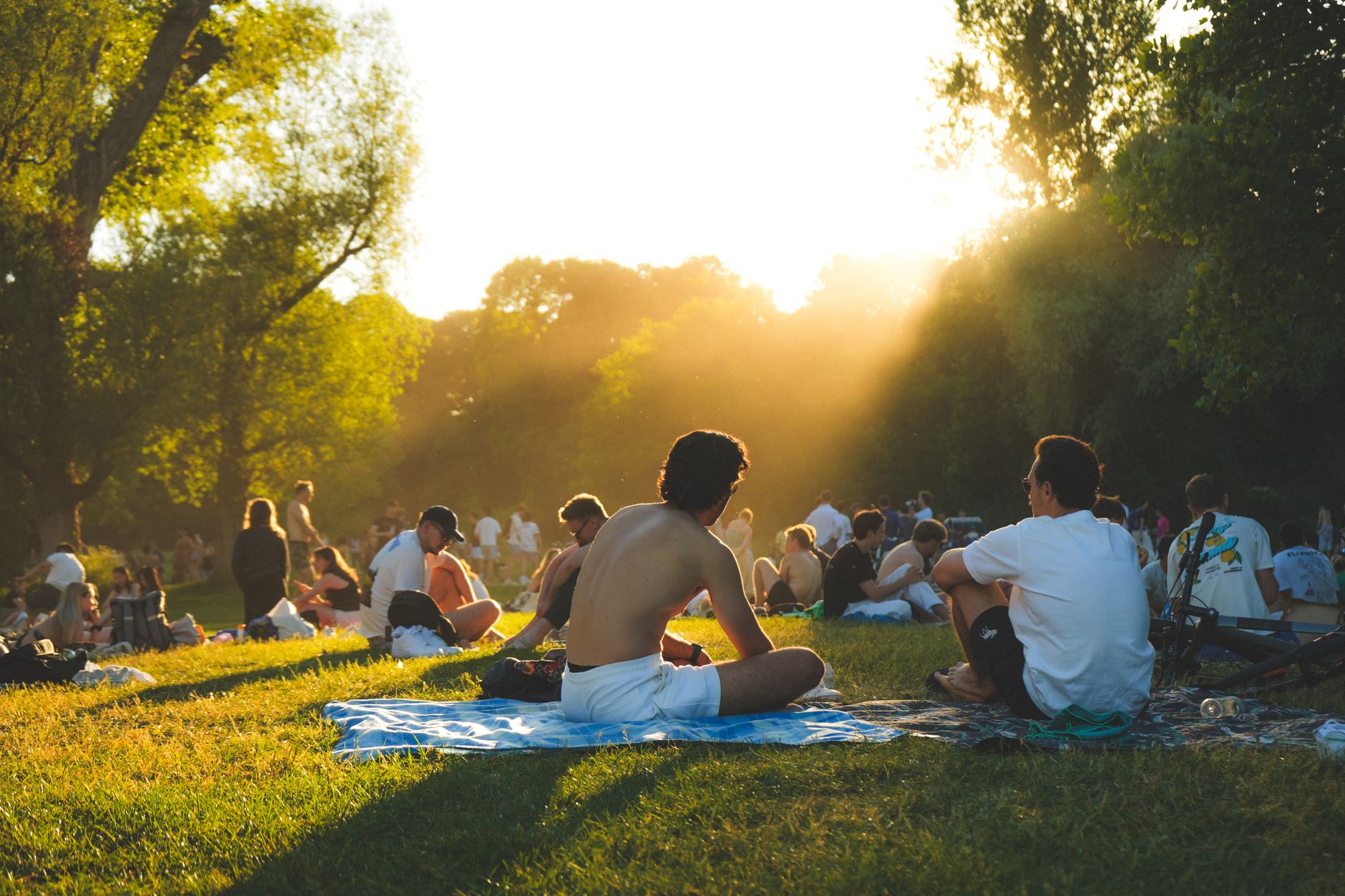
After a lazy morning, during which I lost more time than I would have liked, I headed towards the Weissensee, only to find out that it was packed.
I was missing my girlfriend. I was missing the calmness of the Greek beaches.
“We’re planning to go to Halensee,” she said over the phone while I was standing in line, almost at the entrance to the Weissensee, which was still the best option for me.
I checked my phone. Forty minutes to Halensee.
Forty minutes through the burning city, with the stink of public transport and unfriendly gazes.
Not exactly what I was looking for.
I didn’t know what to do, so I stayed in line a little longer, without really thinking about anything.
Then I found myself waiting for the S42, which was delayed.
Great, I thought, starting to lose my patience.
Almost thirty minutes went by.
“I could be lying on the beach reading my book with a cappuccino now.”
When I finally reached Halensee, I found out that the lake had been temporarily closed because there were too many people.
So I waited in line with a crowd of pissed-off people, all of us annoyed by this unexpected turn of events.
I bought three bracelets.
My girlfriend arrived twenty minutes later. I went up and gave hers to her.
We went down together and found a small spot among the crowd.
It felt claustrophobic. Totally unpleasant.
We sat there in silence.
We didn’t have the energy—or the willingness—to complain anymore.
She went to pick up her friend, who had just texted her.
Her friend came and sat close to us.
She never stopped talking.
Not even when we found out that a guy had disappeared beneath the surface of the water.
Not even when I came back after joining the attempts to rescue him, exhausted and a little shocked by the collective panic.
Not even when the firefighters pulled his lifeless body from the water.
Not even when we were asked to leave and spent ten minutes outside, staring at the ambulances lined up in front of the lake.
Not even when we stopped to eat an ice cream.
Then I was home in Weissensee again, dreading Monday and wishing I were back in Greece on holiday.
Just one more week.