Category Archives: Nonfiction

#77 I Love Berlin, I Hate Berlin

While waiting for people to climb the stairs on their way to board the plane, my girlfriend noticed a woman absorbing the last rays of Greek sunlight.

“She knows where she’s heading,” she shouted at me, trying to be heard above the roar of the wind.

That sentence made me fully realize where we were all heading: Berlin.

So I imitated the woman. I turned my face towards the sun and closed my eyes.

“Fuck, back to Berlin,” I thought.

I love Berlin, I hate Berlin.

I hate Berlin, I love Berlin.


As we flew over the forests of Brandenburg, leaving a series of lakes behind us, I had a strange feeling. It was as if I were about to land in a city I could recognize neither as familiar nor as alien.

“Is this my home?” I asked myself.

The extra hour-long journey from the airport to the flat I rent in Weissensee sucked out the last drops of my energy.


The next day, I ran some errands: washing my clothes, doing some groceries, trying to put my life back into its usual rhythm. Afterwards, I treated myself to lunch at Quadmous, at Am Friedrichshain, even though my wallet—drained by Mykonos—was telling me to stay away.

It was a quiet, uneventful day spent alone.


On Sunday, I wanted to take advantage of the sun and spend the day at the beach.

After a lazy morning, during which I lost more time than I would have liked, I headed towards the Weissensee, only to find out that it was packed.

I was missing my girlfriend. I was missing the calmness of the Greek beaches.

“We’re planning to go to Halensee,” she said over the phone while I was standing in line, almost at the entrance to the Weissensee, which was still the best option for me.

I checked my phone. Forty minutes to Halensee.

Forty minutes through the burning city, with the stink of public transport and unfriendly gazes.

Not exactly what I was looking for.

I didn’t know what to do, so I stayed in line a little longer, without really thinking about anything.

Then I found myself waiting for the S42, which was delayed.

Great, I thought, starting to lose my patience.

Almost thirty minutes went by.

“I could be lying on the beach reading my book with a cappuccino now.”

When I finally reached Halensee, I found out that the lake had been temporarily closed because there were too many people.

So I waited in line with a crowd of pissed-off people, all of us annoyed by this unexpected turn of events.

I bought three bracelets.

My girlfriend arrived twenty minutes later. I went up and gave hers to her.

We went down together and found a small spot among the crowd.

It felt claustrophobic. Totally unpleasant.

We sat there in silence.

We didn’t have the energy—or the willingness—to complain anymore.

She went to pick up her friend, who had just texted her.

Her friend came and sat close to us.

She never stopped talking.

Not even when we found out that a guy had disappeared beneath the surface of the water.

Not even when I came back after joining the attempts to rescue him, exhausted and a little shocked by the collective panic.

Not even when the firefighters pulled his lifeless body from the water.

Not even when we were asked to leave and spent ten minutes outside, staring at the ambulances lined up in front of the lake.

Not even when we stopped to eat an ice cream.

Then I was home in Weissensee again, dreading Monday and wishing I were back in Greece on holiday.

Just one more week.
#76 Letting go of identity: the path to true strength

When identity becomes a cage

The strongest person is the one who doesn’t build his life around an identity.

The moment we become attached to an idea of who we are, we also become vulnerable. We start protecting an image instead of living the truth.

What if we lose that identity?

What if we’re not who we thought we were?

What if our flaws become visible?

Suddenly, our self-worth depends on maintaining a story. That’s where impostor syndrome thrives. That’s where “fake it until you make it” becomes a survival strategy instead of a stepping stone. That’s where FOMO gains power. All of them feed on the same fear: that who we are isn’t enough unless it matches the identity we’ve created.

Our culture amplifies this. We’re constantly encouraged to define ourselves through labels, careers, achievements, ideologies, lifestyles, and online personas. The stronger the attachment, the greater the fear of losing them.

Purpose without attachment

“But don’t we need purpose? Don’t we need to belong?”

Of course we do.

Not identifying with a rigid concept of ourselves doesn’t mean rejecting purpose, ambition, or community. It simply means recognizing that none of those things define our worth.

We can dedicate ourselves to a career without becoming our job. We can fight for a cause without making disagreement feel like a personal attack. We can belong to a community without believing that leaving it would make us less of a person.

Purpose enriches our lives. Identity should never imprison it.

The practice of simply being

We should practice being honest with ourselves.

Become comfortable simply existing.

Learn one new lesson every day, no matter how small.

We must learn again and again to stop comparing our path to everyone else’s. Be grateful for what we know while remaining curious about what we don’t.

Identity should describe our lives—not define our worth.

The strongest people aren’t those with the clearest identity. They’re the ones who can let it go without losing themselves.

#75 Are we starting to sound like AI?

How AI is reshaping the way we speak, think, and present ourselves at work

If you work in a company that heavily uses AI tools, you have probably noticed that everybody starts to sound like a robot. Not during casual corridor chats, but during calls—especially reviews, all-hands meetings, and even one-to-ones.

At a time when society had already begun scrutinizing everything we say in public—where any misstep could potentially lead to “cancellation” or public backlash—it feels like we are moving toward an even more controlled environment. We are so afraid of making mistakes that we rely on machine-generated scripts. And it seems likely that this tendency will only intensify.

Are we silently and unconsciously moving toward an AI-driven form of control? It may be too early to draw firm conclusions, but the direction is worth questioning.

Authorship in the Age of AI: who can claim ownership?

There is another dimension to this. Can we still claim full ownership of what we create when it results from a dialogue with an increasingly capable machine? We tend to believe that we can. However, if we were to apply strict standards of authorship or intellectual honesty, we might need to acknowledge this collaboration explicitly—for example, by stating that a piece is the result of interaction with an AI tool, rather than presenting it as entirely independent work.

The growing presence of AI in daily work raises subtle but important questions about authenticity, authorship, and control. While these tools enhance efficiency, they may also standardize how we think and communicate. The challenge is not to reject them, but to remain conscious of how much of our voice we are willing to delegate—and what that means for the future of human expression.

Have you noticed similar patterns in your organization?

If you are interested in similar topics, you may find these posts relevant:

#74 Half of life happens in our thoughts

Do you ever notice how often your mind drifts away from whatever you’re doing? Well, you are not alone.

The Mind Rarely Stays Still

Research suggests that our minds wander nearly half the time, often drifting to thoughts about the past, the future, or things unrelated to what we are doing. If you live to ninety, roughly forty-two years of your life will unfold inside your own thoughts. Forty-two years distracted—it almost sounds like the title of a comedy… or a drama, depending on the perspective.

As surprising as that may sound, research suggests it’s actually how people normally operate. The real difference lies in the quality of those drifting thoughts. So instead of spending all that time blaming yourself for “not being productive enough,” consumed by FOMO or regrets, accept reality and enjoy your humanness—even in the form of distractions. Paradoxically, that acceptance may help you be more present.

Awareness Over Control

Maybe the problem isn’t that we spend too much time distracted. Perhaps the problem is believing we should always be on top of things with laser focus. If half of life naturally unfolds in our thoughts, maybe the goal isn’t to eliminate that time—but to improve the quality of what happens there.

There is no magic formula for this, and one needs to apply their own tools to figure out their path towards improvement. However, awareness is always a good first step.

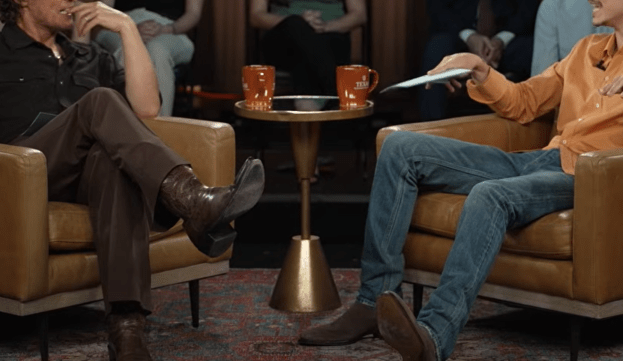
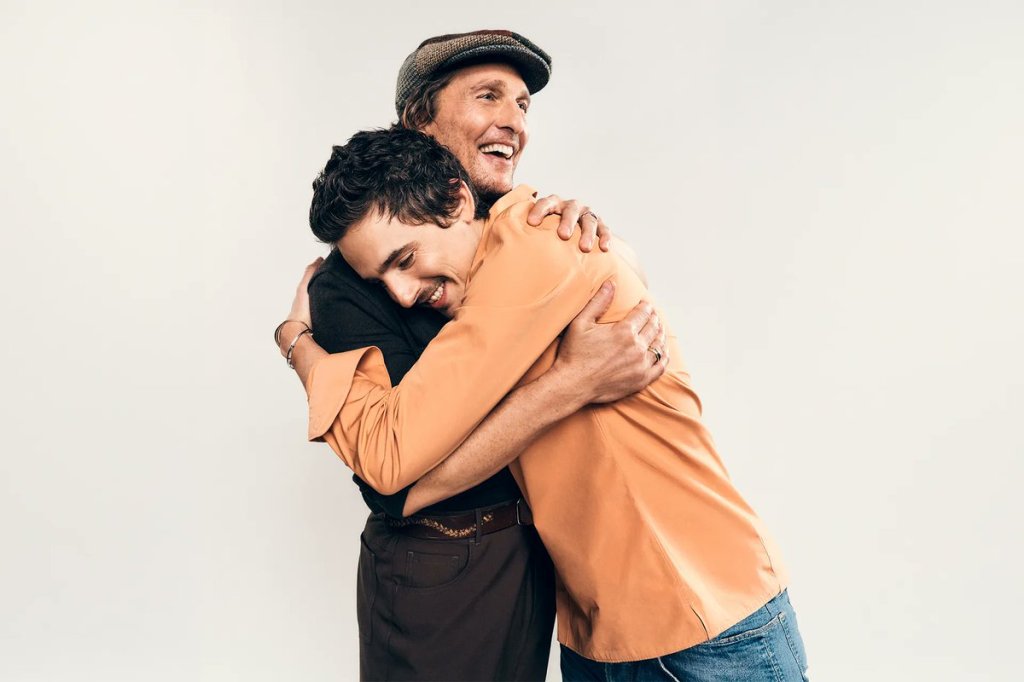
Timothée Chalamet and Matthew McConaughey speaking during a CNN town hall interview.

#73 Do you know the origin of your complacency? — Chalamet & McConaughey conversation

A conversation between Timothée Chalamet and Matthew McConaughey

There is an engaging podcast-style conversation between Matthew McConaughey and Timothée Chalametthat sparks reflections on complacency.

They spend over an hour talking about their careers and their experience in the movie industry, while also taking questions from students.

Beyond the backstage secrets revealed and the lightness and confidence with which they talk about personal experiences, one can notice the gratitude they have for having been able to approach life with curiosity and freedom.

Chalamet expresses that very well when he says:

First of all, I’m incredibly lucky with the family and support system I’ve had from the beginning. And I know how lucky I am because I’ve talked to peers of mine who haven’t had the same support system, where it’s more the clichés of, hey, this person wants something out of you — sometimes in a really dark way, in a financial way or whatever. It can be hard to get those dynamics.

The impact of family expectations on the individual

As Chalamet mentions so naturally and clearly here, family support without expectations — without the pressure to become this or that so parents can brag about their children to neighbours, or project their failed dreams onto them, or even expect them to become rich and successful to exploit their image or finances — is crucial.

From a purely observational point of view, we could say that, sadly, most people do not have this luxury to begin with, as Chalamet did. That alone already sets him apart. Having emotionally intelligent, present, and mature parents is an absolute blessing — maybe the biggest blessing one can wish for in life. Let alone parents who consciously choose to give minimal but effective guidance, weighing their words and emotions carefully, and offering their children a safe and genuine degree of freedom to explore life with curiosity and a sense of security.

The latter is a rare parental skill that requires multidimensional levels of intelligence, leadership, and egolessness — the awareness that love can be expressed by letting go of expectations and simply allowing the other to be whatever they feel interested in becoming, as long as no self-harm or harm to others is involved.

The burden of figuring things out for oneself

So we could argue that despite some people reaching a satisfying degree of freedom and self-awareness at some point in their lives, most of them have to fight hard to obtain it — and then to figure out how to be themselves and enjoy it — to the point that the effort almost overshadows the pleasure that comes from it.

One can only appreciate the lightness, kindness, and warmth that these two express while debating. And the genuine honesty and humbleness they display when opening up about certain topics.

Their ease is not accidental; it reflects a foundation. It’s easier to accept yourself when you realize that the maturity and warmth of others may originate from a system that was not accessible to you. Recognising that can shift the focus from envy to understanding. From that acceptance, one can develop maturity and warmth in oneself, which means it can still be built — if that makes sense. It may require conscious reconstruction rather than inheritance. It also depends on the receptiveness of the audience, where they decide to focus and where they stand on their own journey.

On the topic of complacency

From another angle, we could argue that trying to satisfy parents’ expectations without rebelling, which can happen due to fear, conditioning, and pressure coming from multiple sources within a family system, can turn someone into a complacent individual, a people pleaser.

Some parents are insanely attached to an idealized future version of their children — a specific picture in mind that they desperately want to manifest, so that their children grow up without a clear idea of what they want from life. They only start figuring that out too late and too slowly. At that point, they want to be successful in something — anything. Even though success is not necessarily the right metric for satisfaction in life. Passion, development, coexistence, and self-awareness may instead be more accurate measures.

Many other factors can turn someone into a complacent individual: the desire to adapt to a specific context, to align with social rules and codes of conduct—especially nowadays, when cultural environments are more mixed than ever.

An inspiring closing

At the end of the interview, a young woman asks the two a classic question: “What would you tell your younger selves?”

McConaughey’s answer is direct:

I know you love risk and you take them. Take more.

It is simple advice, but not easy advice.

It seems like a strong antidote to that complacency that is imposed from outside and that everyone eventually learns to impose on themselves — in order to feel more comfortable and safe. This is understandable after years of struggle, yet it runs against a fundamental principle of life:

Growth requires exposure to risk.

a person making a letter with a cup of smoking coffee nearby

#72 Pages from a Moleskine 2: The cost and reward of setting boundaries

Listen to this post

Paris, January 1st, 2024

I’m starting to understand now what my mother told me yesterday, or at least I’m coming up with my own interpretation of the message in her words.

To feel a mix of egoism, hypocrisy, and guilt when you put yourself first—when you set healthy boundaries and stand up for yourself—is normal. On the other hand, you may feel a sense of pride, joy, and self-worth for finally being able to protect yourself independently.

Everything comes at a cost, and for everything there is a reward.

We need to learn to see both aspects in every sphere of life. Appreciation for life, a sense of belonging to the collective, and finding our place on this planet also come from the realization and acceptance of this duality.

Through victimization, we can only wander around in pain, loneliness, and resentment.

There is a fine line between caring about those we love and caring about ourselves, but the latter should always prevail, because the person we spend the most time with is ourselves. That’s the relationship we should cherish the most.

That doesn’t mean mistreating or disregarding others. It means nurturing self-compassion above all else to protect ourselves during the most painful moments that we will inevitably encounter throughout our lifetime.

It may seem counterintuitive, but part of the process that brings this awareness, deep understanding, and integration of these learnings is also letting go of the ego and the need for validation from others. It means knowing that we are enough, that we can lose anything and still be content as long as we don’t lose ourselves.

Ultimately, maturity is not about detachment from others, but about alignment with ourselves. When we are grounded in who we are, we stop negotiating our worth. From that place, relationships become choices—not dependencies—and solitude becomes presence, not absence.