Author Archives: Carlos

Unknown's avatar

About Carlos

I love writing.

#75 Are we starting to sound like AI?

How AI is reshaping the way we speak, think, and present ourselves at work

If you work in a company that heavily uses AI tools, you have probably noticed that everybody starts to sound like a robot. Not during casual corridor chats, but during calls—especially reviews, all-hands meetings, and even one-to-ones.

At a time when society had already begun scrutinizing everything we say in public—where any misstep could potentially lead to “cancellation” or public backlash—it feels like we are moving toward an even more controlled environment. We are so afraid of making mistakes that we rely on machine-generated scripts. And it seems likely that this tendency will only intensify.

Are we silently and unconsciously moving toward an AI-driven form of control? It may be too early to draw firm conclusions, but the direction is worth questioning.

Authorship in the Age of AI: who can claim ownership?

There is another dimension to this. Can we still claim full ownership of what we create when it results from a dialogue with an increasingly capable machine? We tend to believe that we can. However, if we were to apply strict standards of authorship or intellectual honesty, we might need to acknowledge this collaboration explicitly—for example, by stating that a piece is the result of interaction with an AI tool, rather than presenting it as entirely independent work.

The growing presence of AI in daily work raises subtle but important questions about authenticity, authorship, and control. While these tools enhance efficiency, they may also standardize how we think and communicate. The challenge is not to reject them, but to remain conscious of how much of our voice we are willing to delegate—and what that means for the future of human expression.

Have you noticed similar patterns in your organization?

If you are interested in similar topics, you may find these posts relevant:

#74 Half of life happens in our thoughts

Do you ever notice how often your mind drifts away from whatever you’re doing? Well, you are not alone.

The Mind Rarely Stays Still

Research suggests that our minds wander nearly half the time, often drifting to thoughts about the past, the future, or things unrelated to what we are doing. If you live to ninety, roughly forty-two years of your life will unfold inside your own thoughts. Forty-two years distracted—it almost sounds like the title of a comedy… or a drama, depending on the perspective.

As surprising as that may sound, research suggests it’s actually how people normally operate. The real difference lies in the quality of those drifting thoughts. So instead of spending all that time blaming yourself for “not being productive enough,” consumed by FOMO or regrets, accept reality and enjoy your humanness—even in the form of distractions. Paradoxically, that acceptance may help you be more present.

Awareness Over Control

Maybe the problem isn’t that we spend too much time distracted. Perhaps the problem is believing we should always be on top of things with laser focus. If half of life naturally unfolds in our thoughts, maybe the goal isn’t to eliminate that time—but to improve the quality of what happens there.

There is no magic formula for this, and one needs to apply their own tools to figure out their path towards improvement. However, awareness is always a good first step.

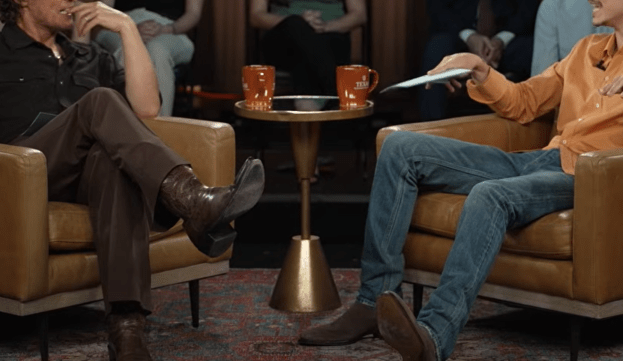
Timothée Chalamet and Matthew McConaughey speaking during a CNN town hall interview.

#73 Do you know the origin of your complacency? — Chalamet & McConaughey conversation

A conversation between Timothée Chalamet and Matthew McConaughey

There is an engaging podcast-style conversation between Matthew McConaughey and Timothée Chalametthat sparks reflections on complacency.

They spend over an hour talking about their careers and their experience in the movie industry, while also taking questions from students.

Beyond the backstage secrets revealed and the lightness and confidence with which they talk about personal experiences, one can notice the gratitude they have for having been able to approach life with curiosity and freedom.

Chalamet expresses that very well when he says:

First of all, I’m incredibly lucky with the family and support system I’ve had from the beginning. And I know how lucky I am because I’ve talked to peers of mine who haven’t had the same support system, where it’s more the clichés of, hey, this person wants something out of you — sometimes in a really dark way, in a financial way or whatever. It can be hard to get those dynamics.

The impact of family expectations on the individual

As Chalamet mentions so naturally and clearly here, family support without expectations — without the pressure to become this or that so parents can brag about their children to neighbours, or project their failed dreams onto them, or even expect them to become rich and successful to exploit their image or finances — is crucial.

From a purely observational point of view, we could say that, sadly, most people do not have this luxury to begin with, as Chalamet did. That alone already sets him apart. Having emotionally intelligent, present, and mature parents is an absolute blessing — maybe the biggest blessing one can wish for in life. Let alone parents who consciously choose to give minimal but effective guidance, weighing their words and emotions carefully, and offering their children a safe and genuine degree of freedom to explore life with curiosity and a sense of security.

The latter is a rare parental skill that requires multidimensional levels of intelligence, leadership, and egolessness — the awareness that love can be expressed by letting go of expectations and simply allowing the other to be whatever they feel interested in becoming, as long as no self-harm or harm to others is involved.

The burden of figuring things out for oneself

So we could argue that despite some people reaching a satisfying degree of freedom and self-awareness at some point in their lives, most of them have to fight hard to obtain it — and then to figure out how to be themselves and enjoy it — to the point that the effort almost overshadows the pleasure that comes from it.

One can only appreciate the lightness, kindness, and warmth that these two express while debating. And the genuine honesty and humbleness they display when opening up about certain topics.

Their ease is not accidental; it reflects a foundation. It’s easier to accept yourself when you realize that the maturity and warmth of others may originate from a system that was not accessible to you. Recognising that can shift the focus from envy to understanding. From that acceptance, one can develop maturity and warmth in oneself, which means it can still be built — if that makes sense. It may require conscious reconstruction rather than inheritance. It also depends on the receptiveness of the audience, where they decide to focus and where they stand on their own journey.

On the topic of complacency

From another angle, we could argue that trying to satisfy parents’ expectations without rebelling, which can happen due to fear, conditioning, and pressure coming from multiple sources within a family system, can turn someone into a complacent individual, a people pleaser.

Some parents are insanely attached to an idealized future version of their children — a specific picture in mind that they desperately want to manifest, so that their children grow up without a clear idea of what they want from life. They only start figuring that out too late and too slowly. At that point, they want to be successful in something — anything. Even though success is not necessarily the right metric for satisfaction in life. Passion, development, coexistence, and self-awareness may instead be more accurate measures.

Many other factors can turn someone into a complacent individual: the desire to adapt to a specific context, to align with social rules and codes of conduct—especially nowadays, when cultural environments are more mixed than ever.

An inspiring closing

At the end of the interview, a young woman asks the two a classic question: “What would you tell your younger selves?”

McConaughey’s answer is direct:

I know you love risk and you take them. Take more.

It is simple advice, but not easy advice.

It seems like a strong antidote to that complacency that is imposed from outside and that everyone eventually learns to impose on themselves — in order to feel more comfortable and safe. This is understandable after years of struggle, yet it runs against a fundamental principle of life:

Growth requires exposure to risk.

a person making a letter with a cup of smoking coffee nearby

#72 Pages from a Moleskine 2: The cost and reward of setting boundaries

Listen to this post

Paris, January 1st, 2024

I’m starting to understand now what my mother told me yesterday, or at least I’m coming up with my own interpretation of the message in her words.

To feel a mix of egoism, hypocrisy, and guilt when you put yourself first—when you set healthy boundaries and stand up for yourself—is normal. On the other hand, you may feel a sense of pride, joy, and self-worth for finally being able to protect yourself independently.

Everything comes at a cost, and for everything there is a reward.

We need to learn to see both aspects in every sphere of life. Appreciation for life, a sense of belonging to the collective, and finding our place on this planet also come from the realization and acceptance of this duality.

Through victimization, we can only wander around in pain, loneliness, and resentment.

There is a fine line between caring about those we love and caring about ourselves, but the latter should always prevail, because the person we spend the most time with is ourselves. That’s the relationship we should cherish the most.

That doesn’t mean mistreating or disregarding others. It means nurturing self-compassion above all else to protect ourselves during the most painful moments that we will inevitably encounter throughout our lifetime.

It may seem counterintuitive, but part of the process that brings this awareness, deep understanding, and integration of these learnings is also letting go of the ego and the need for validation from others. It means knowing that we are enough, that we can lose anything and still be content as long as we don’t lose ourselves.

Ultimately, maturity is not about detachment from others, but about alignment with ourselves. When we are grounded in who we are, we stop negotiating our worth. From that place, relationships become choices—not dependencies—and solitude becomes presence, not absence.

#71 How people actually use AI (not just talk about it)

I read a lot about AI — but not about how people actually use it

I read a lot of stuff about AI all over the place, but what I rarely read about is how people are actually using it, in practical terms. Everybody talks about their projects, but almost nobody describes the processes and the day-to-day tricks that help them finalize those projects with accuracy and success.

Maybe I’m not the most reliable person to make such a statement. There are probably communities that discuss this extensively. But I’m the average guy when it comes to this topic: learning by doing and checking three or four sources regularly (YouTube being one of them).

That said, the work environments I’ve been part of recently have been my best source of knowledge when it comes to using AI tools. One thing I’ve noticed is that most people I interact with are learning to use these tools in very different ways. It’s a deeply personal approach — one that reflects how we deal with many other aspects of life.

There’s the methodical AI user, the scared one, the spontaneous one, the skeptical one, the addicted one. Then there are the philosophies:
the doomsday thinker who believes robots will take over the world within six months;
the optimist who thinks cancer will be eradicated soon;
the world conqueror who wants to develop chips to enhance intelligence and learn kung-fu like Neo in The Matrix.

And so on, and so forth.

What I want to share here are four super-intuitive tips — plus two extra ones — that are genuinely helping me every day to crack and solve problems that felt extremely complex and time-consuming before AI entered the picture.

This is not a guide about AI projects or future promises, but about practical AI use in daily work, learning by doing, and building workflows that actually save time.

And the best part? You can apply them immediately and start improving your current (and future) opportunities right now.


Tip n. 1 — Treat AI like a smart collaborator, not a magic box

I’ve seen friends and colleagues share results obtained from a single prompt — no exchange further exchange with the AI tool, just one prompt. Sure, maybe Sam Altman is capable of writing a prompt so perfect that no follow-up is required.

But most of us absolutely need to dig into the results of our prompts — until all the dark corners, potential misleading information, and questionable sources are double, triple, quadruple-checked.

I’ve noticed that when I carefully read what AI returns — like actively listening to a colleague, a good friend or a partner — the follow-up questions improve exponentially, and the quality of the next outputs is on a completely different level.

Tip n. 2 — Improve your prompts before execution

If I’m not mistaken, tools like Copilot already offer an agent that does this by default. But you can easily create your own prompt that says:

“Please, correct and improve this prompt: [prompt here]”

And before you say anything about the word please: I say “good morning” to my AI tools every day. You never freaking know! But I’ve watched too many sci-fi movies…

Tip n. 3 — Use screenshots to learn tools faster with AI

Let’s say you have a blog like mine and you want to use Google Analytics (GA) to improve your keywords, understand your audience, and so on.
(Things that — as I’ve said many times across my posts — I don’t do for my personal blog. This is a hobby, not a validation machine, and I refuse to enter the paranoia-wheel of likes, comments, subscribers, and views.)

But let’s pretend you do want to do that — and you’ve never used GA before.

If you go through the official GA guidelines, there’s so much content out there that before you even start using the tool, your head is already spinning.

So what do you do?

You create an account (easy enough), and then for any doubt you have — no matter how silly — you just take a screenshot and ask ChatGPT, Copilot, Perplexity, or whatever you use:

“I don’t understand what to do next. Please explain concisely, step by step, in simple terms.”

You’re welcome. You’ll can come back to thank me later.

Tip n. 4 — Use AI to summarize and explore the web efficiently

Give AI the websites you want to summarize or explore faster.

For example:

“Crawl website www.xyzittttyb.co.uk and give me the most relevant links related to xyz.”

It’s a dumb example, obviously — but you can crawl websites for much more exciting things than that.

Extra tip — Clean, refine, and share for feedback

I’ve heard people say they want to keep their prompts and results secret so others don’t copy their ideas 🤦🏽‍♂️… Some people operate on levels of confidence and delusion that are simply beyond my reach. They think they’re freaking Einstein or Tesla, I don’t know.

Guys, the era where isolated geniuses existed is over. Accept it.

Knowledge is now accessible to anyone with an internet connection, curiosity, and enough time to play with AI tools and develop skills. The more you share, the more you learn: people give feedback, you discover your flaws, and you improve.

Observe what others do. Be humble.
Follow the Socratic idea: “To know is to know that you know nothing.”Doors will keep opening new paths constantly.

Think you know everything, and your horizon will be as wide as the space between your ears.

Extra tip n. 2 — Summarize YouTube videos

Just copy-paste the transcript and ask AI to summarize it. Hours of few in a few minutes read.

That’s it. No magic. Just leverage what’s already there.

Bottom line

Practical AI use isn’t about better tools — it’s about better questions, better iteration, and treating AI as part of your daily workflow instead of a shortcut machine.
It doesn’t require genius-level prompts, secret tricks, or futuristic visions. It rewards curiosity, patience, iteration, and humility. Treat it like a conversation, let it help you think more clearly, and don’t be afraid to share what you learn. The real advantage isn’t knowing more — it’s learning faster, together.

#70 A proper winter, and an improper amount of complaining

After last Christmas, temperatures here in Berlin dropped and never really rose again. Daily snow, frozen lakes, and icy streets turned into routine. So did people going to the hospital with broken bones after slipping on ice. Public transportation became a nightmare—if not absolute s***.

People’s faces shifted from the usual grumpiness, the don’t-look-at-me attitude, to full-on I’m-going-to-kill-someone expressions. Many fled Germany because, for them, it was “too much to handle,” life-threatening even. They went somewhere sunny to stay alive.

I have to admit that, for a while, I was starting to get dragged into this collective incapacity to live through winter (and I am freaking Brazilian-Italian!). But then I thought: fuck this mentality. Let me appreciate the beauty of this time of year.

I usually enjoy life the most when I’m on my own—it’s just how I am, and I love that about myself. It’s one of my biggest strengths. That was the first breakthrough that helped me reconsider the season. I could finally enjoy my alone time even more, thanks to the slowness, the quietness, and the stillness winter brings.

The second breakthrough came when I stopped complaining to myself.

Social complaining in Germany is unavoidable—it’s almost a way of socializing—so in that sense I go along with conversations. When I’m on my own, though, I actively avoid it. It’s not a New Year’s resolution or anything like that; I just try to catch myself early when I fall into that pattern.

It took me a while to fully understand what scientists have been repeating for years, but when I complain alone, I reinforce a story in my head—and that’s not good (nicht gut!). I spiral into deeply depressing thoughts and start feeling like I’m drowning in them.

So I made a real effort to internally flip the narrative. Suddenly, what had been a dark, shitty day turned into a cozy one, with dimmed lights and the freedom to do whatever I wanted—or nothing at all. Especially my alone time turned into bliss. To be fair, it has always been blissful for me to spend time alone. I find the opposite incredibily difficult. But this winter, I’ve been slowing down even more.

There was a third breakthrough… there was one. But I forgot it.

To close, I’ll repeat one of the mantras that comes back often in my writing: self-compassion, self-compassion, self-compassion is the key. It doesn’t matter if you’re surrounded by amazing people—if you’re shitty toward yourself, you’re creating the conditions to rot in misery. And that’s not what we want.

We want self-compassion. Not denial. Not lying to oneself. Just appreciating our existence as it is. Easier said than done—it’s a life-long quest for all of us. But practice makes perfect.