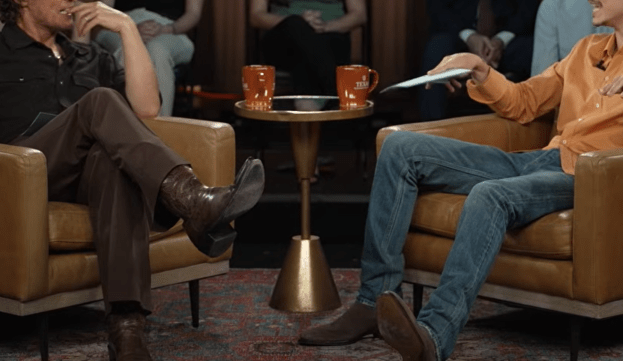
A conversation between Timothée Chalamet and Matthew McConaughey
There is an engaging podcast-style conversation out there between Matthew McConaughey and Timothée Chalamet that sparks reflections on complacency.
They spend over an hour talking about their careers and their experience in the movie industry, while also taking questions from students.
Beyond the backstage secrets revealed and the lightness and confidence with which they talk about personal experiences, one can notice the gratitude they have for having been able to approach life with curiosity and freedom.

Chalamet expresses that very well when he says:
First of all, I’m incredibly lucky with the family and support system I’ve had from the beginning. And I know how lucky I am because I’ve talked to peers of mine who haven’t had the same support system, where it’s more the clichés of, hey, this person wants something out of you — sometimes in a really dark way, in a financial way or whatever. It can be hard to get those dynamics.
The impact of family expectations on the individual
As Chalamet mentions so naturally and clearly here, family support without expectations — without the pressure to become this or that so parents can brag about their children to neighbours, or project their failed dreams onto them, or even expect them to become rich and successful to exploit their image or finances — is crucial.
From a purely observational point of view, we could state that (sadly) the majority of people do not have this luxury to begin with, as Chalamet did, and that sets him apart from most people already. Having emotionally intelligent, present, and mature parents is an absolute blessing — maybe the biggest blessing one can wish for in life. Let alone parents who consciously choose to give minimal but effective guidance, weighing their words and emotions carefully, and offering their children a safe and genuine degree of freedom to explore life with curiosity and a sense of security.
The latter is a rare parental skill that requires multidimensional levels of intelligence, leadership, and egolessness — the awareness that love can be expressed by letting go of expectations and simply allowing the other to be whatever they feel interested in becoming, as long as no self-harm or harm to others is involved.
The burden of figuring things out for oneself
So we could argue that despite some people reaching a satisfying degree of freedom and self-awareness at some point in their lives, most of them have to fight hard to obtain it — and then to figure out how to be themselves and enjoy it — to the point that the effort almost overshadows the pleasure that comes from it.
One can only appreciate the lightness, kindness, and warmth that these two express while debating. And the genuine honesty and humbleness they display when opening up about certain topics.
Their ease is not accidental; it reflects a foundation. It’s easier to accept yourself when you realize that the maturity and warmth of others may originate from a system that was not accessible to you. Recognising that can shift the focus from envy to understanding. From that acceptance, one can develop maturity and warmth in oneself, which means it can still be built — if that makes sense. It may require conscious reconstruction rather than inheritance. It also depends on the receptiveness of the audience, where they decide to focus and where they stand on their own journey.
On the topic of complacency
From another angle, we could argue that trying to satisfy parents’ expectations without rebelling, which can happen due to fear, conditioning, and pressure coming from multiple sources within a family system, can turn someone into a complacent individual, a people pleaser.
Some parents are insanely attached to an idealized future version of their children — a specific picture in mind that they desperately want to manifest, that their children grow up without a clear idea of what they want from life. They only start figuring that out too late and too slowly. At that point, they want to be successful in something — anything. Even though success is not necessarily the right metric for satisfaction in life. Passion, development, coexistence, and self-awareness may instead be more accurate measures.
Many other factors can turn someone into a complacent individual: the desire to adapt in a specific context, aligning with social rules, codes of conduct, especially nowadays, when the mix of cultures is greater than ever.
An inspiring closing
At the end of the interview, a young woman asks the two a classic question: “What would you tell your younger selves?”
McConaughey’s answer is direct:
I know you love risk and you take them. Take more.
It is simple advice, but not easy advice.
It seems like a strong antidote to that complacency that is imposed from outside and that everyone eventually learns to impose on themselves — in order to feel more comfortable and safe. Which is understandable after years of fighting and grinding, but at the same time goes against a fundamental principle of life: growth requires exposure to risk.
