
Listen to this post
When I watched the third season of The Diplomat last weekend, by the end of it I felt disappointed—but I couldn’t quite tell why. Then, while discussing it with my girlfriend, I started comparing it to House of Cards, and things became a bit clearer.
House of Cards: a villain’s journey
In House of Cards, we follow politicians constantly walking a thin line between crime and legality, all while being pursued by relentless media investigations. Their desperate attempts to obstruct the journalists who hunt them down lead them to commit increasingly horrible crimes.
That, as simple as it sounds, is the show’s secret formula: it’s a villain’s journey, not a hero’s one. Frank and Claire Underwood create Machiavellian plans to gain ever more power and ultimately conquer the world. The media try to expose them, but the Underwoods manipulate everyone around them—using every dirty trick possible—to come out on top.
They betray both allies and opponents, many of whom crumble under the pressure of being framed and exposed. The only survivors are Frank and Claire: a psychopathic couple whose deceit and manipulation keep us glued to the screen. Despite everything, they remain loyal to each other.
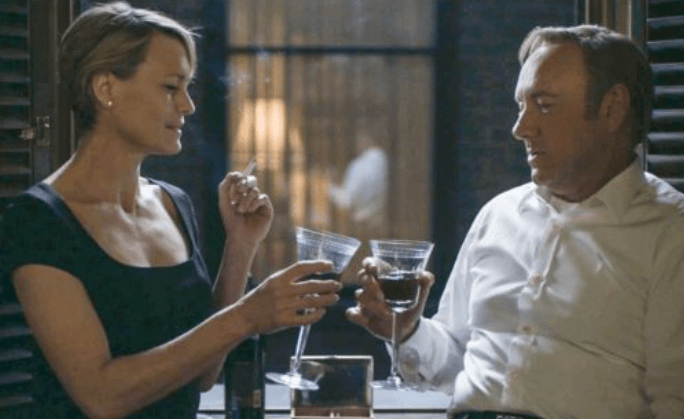
And that’s what we love about the show. Beneath all the corruption and ruthlessness, there’s an unbreakable bond—an unconditional love encompassing romance, friendship, partnership, and shared ambition. It transcends everyone and everything else. They are there for each other, no matter how dark the deeds. At least in the first two seasons, if I remember well… before things start to collapse.
The Diplomat: psychological politics
In The Diplomat, by contrast, we see a bunch of reckless players acting unchecked behind the scenes, seemingly with total impunity. They have a blank check to do whatever they want, which feels far removed from reality—especially in the American political system, where influential media like The Wall Street Journal and The Washington Post usually go to great lengths to expose wrongdoing, when they manage to grasp the full picture.
Kate and Hal Wyler, the couple at the heart of the show, have gone too far without ever having a real conversation about their problems, desires, needs, or pains. We meet them on the brink of divorce, and eventually, they do separate. They compete against each other, weighed down by doubts and insecurities.
Writing this now, I realize I actually appreciate the humanity of these two. Relationships are tough—no matter how powerful, rich, or influential you are—and the show captures that realism beautifully. I also like how flawed and conflicted everyone is. Aren’t we all?
We live in an age where it’s not just about pretending for others; we often end up lying to ourselves too. As a society, we’ve become both the performers and the audience of our own self-deception.
Are you not entertained?
Kind of—but not really.
Despite all these interesting layers, The Diplomat often feels more like a mockumentary than a political drama. The plot seems unnecessarily convoluted, and the dialogue is hard to follow at times. I kept feeling like I was missing something crucial.
Another aspect that caught my attention was the absence of characters representing figures like the Secretary of State and the Secretary of Defense—at least not in a consistent way. In a geopolitical thriller where the focus is clearly on the United States, the lack of these two key roles doesn’t make much sense.
The show also struggles to establish a clear antagonist—which, by contrast, in House of Cards was represented by the media. Here, the characters are their own enemies—an idea that could open deeper philosophical debates, but for a thriller, it risks losing the viewer’s emotional anchor. Geopolitics is indeed a complex, multidimensional puzzle, but as an audience, we still need to understand the stakes.
Maybe my expectations were too high for the second and third seasons, since the first one blew me away. Or maybe times have changed, and the creators are trying to capture something more elusive: our inner and outer chaos, the unpredictability of human behavior, and the blurring lines between hero and villain in a world of shifting power dynamics.
Perhaps that’s the point—how we think we understand reality, until a moment later, we realize we have no idea what’s happening.
